Total Pageviews

Thursday, 21 March 2013

Fewer Calories, More Obesity?


Weight gain, according to pretty much everyone who has studied the subject, is the result of an energy imbalance: consuming more calories than your body burns. Some experts, of course, have proposed that our current obesity epidemic is based on factors more complex than this simple equation, such as an increase in sugar consumption or even changes in our epigenome. But while these proposed explanations may explain certain habits, cravings, and even metabolic changes, none of them directly contradict the understanding that weight, in the end, depends on energy balance.
So a study released late last month, showing that average calorie consumption in the United States has fallen while the rate of obesity has climbed, was a surprise to many — including the study’s own authors. Published online by the American Journal of Clinical Nutrition, the study used data on food consumption from nine national surveys conducted between 1971 and 2010, covering over 60,000 adults between the ages of 20 and 74. According to the data from these surveys, average daily calorie intake rose from 1,955 in the period of 1971–1975 to 2,269 in the period of 2003–2004. By 2009–2010, however, the rate had dropped to 2,195 calories per day, representing a statistically significant drop that should, in theory, have some effect on obesity rates.
But obesity rates, of course, haven’t fallen. According to an article on the study at DiabetesInControl.com, since 1999, the obesity rate for women has remained steady at about 35%. During that same period, however, the obesity rate for men has increased from 27% to 35%. With such a pronounced increase in obesity, one would expect to see a corresponding increase in calories consumed, since there is considerable doubt that a reduction in physical activity could be solely responsible for it.
So what could be the reason for these seemingly incompatible trends? One possible answer is that the conventional wisdom is wrong about the relationship between calories and weight — that at least in some cases, the body’s metabolism could get slower when fewer calories are consumed, leading to weight gain. Another possibility is that Americans, or at least American men, have in fact become far less physically active since 1999; finding data to support this assertion, however, might be difficult. And, of course there is the possibility that the survey data are wrong. As an article at Fox Newsnotes, increased awareness of the dangers of excessive calorie consumption, and possibly of sugary beverages in particular, may have led respondents to underreport their calorie intake in the most recent set of years.
What do you think is the most likely explanation for the reported drop in calorie consumption, in the face of rising obesity rates? Have you ever gained weight despite eating less, or despite an unchanged diet? If so, what do you think was the most likely explanation for the weight gain? Have you witnessed a general drop in physical activity in your community, or is there another factor aside from diet that you think might be contributing to weight gain?
Graham

Evie discovers It's a cruel world !


Evelyn takes some time out to visit her shrink Hannibal Lecter !


The Silence Of The Spams !

Oh no Evelyn, your ham fisted riposte just won’t do, I had expected so much more from you. Do you think you can dissect me with your fly blown blog. You know what you look like to me Evelyn, with your bag of donuts and packets of crisps? You look obese, overweight, and a high carb low fat failure. Good nutrition’s given you some length of bone, but too many carbs have lead to your downfall. You’re not more than one box of chocolates away from your next hyper, are you, Evelyn.

Evelyn, and that accent you've tried so desperately to shed, pure West Bronx. You know how quickly the tuck shop found you, all those tedious sticky fumblings at the back of the class, with Krispy Kreme do-nuts and chocolate digestives, While you could only dream of getting out…... Getting…anywhere.….getting all the way…….to the weight watchers club.

You see a lot Dr. Lecter but can you …….shut it Evie !

An anti lowcarb dietition once tried to test me, I ate her laptop with some fava beans and a nice Chianti.

Tell me Evelyn why do you spend so much time rubbishing others, why is this new one Carbsaner taking you apart ? Don’t lie because I will know. Err Err I accuse too many people of untruths and have pissed off too many people. And why is your blog sinking without trace. Err  Err because people have seen through me and won’t  buy the bull shit anymore.

First principles Evelyn, Simplicity. Read Marcus Aurelius. Of each particular thing ask: what is it in itself? What is its nature? What do you do, what do you seek? Err sticky buns, NO ! What is the first and principal thing that drives you? cakes. NO !, err err….lots of girl on girl action with Melissa McEwen, NO !, that is incidental. You covet, that is your nature. And how do we begin to covet, Evelyn ? We covet with our eyes. What needs do you serve by rubbishing Jimmy Moore and Gary Taubes? Anger, um, social acceptance, and, huh, sexual frustrations, NO, We begin by coveting what we see every day. Don't you love eating those donuts and chocolate biscuits Evelyn? and don't your eyes seek out the things you want ? Err yes.

Why do you hide out on your blog, encouraging dullards and wasters to bad mouth good people. Winding up that awful Richard Nikoley is understandable, but why the others ?

Err because people like them and they make a living from what they do and they have passion. I haven’t even got the courage to say what I really think, so I let my lap dogs and lickspittles do my really dirty work. I think I am a scientist and know it all but I can’t lose weight myself.

Do you want to be helped Evelyn ? Yes I need help, I’m becoming a fruit cake. That has been your downfall Evelyn too many cakes, biscuits and fries. What can I do ?

Look for severe childhood disturbances associated with roast spuds, rice, and junk food. You wasn't born a glutton, and an anti lowcarber Evelyn. You was made one through years of systematic sugar and starch abuse. You hate your own identity, you see, and you think if you can bring everyone down to your level, you will feel good about yourself. That you won‘t wake up in the middle of the night, screaming and craving sticky buns, you won’t be the only one raiding the biscuit barrel, and shovelling pies and cakes down your neck, you won't be the only one that can’t say no to Robb Wolf. Am I right, or am I right?

You are right Hannibal. Thank you Evelyn

Evelyn, one more thing, hate your pants.

Eddie

Wednesday, 20 March 2013

Let Them Eat Fat: Ron Rosenbaum

Listening to the doctors on cable TV, you might think that it's better to cook up a batch of meth than to cook with butter. But eating basic, earthy, fatty foods isn't just a supreme experience of the senses—it can actually be good for you.

The hysterical crusade against fat has become a veritable witch hunt. With New York City Mayor Michael Bloomberg's ban on supersize sodas (now temporarily thwarted) and the first lady's campaign to push leaves and twigs (i.e., salad) on reluctant school children—all in the name of stamping out obesity—it is fat-shaming time in America. Yes, there are countertrends, like the pro-fat TV shows of Paula Deen and Guy Fieri. But in the culture at large, eating that kind of fat has become a class-based badge of shame: redneck food (which I say as someone who likes rednecks and redneck food). It isn't food for someone who drives a Prius to Pilates class.


But there's another world of fatty foods, a world beyond bacon and barbecue—not the froufrou fatty foods of foodies either, but basic, earthy, luxuriant fatty foods like roast goose, split-shank beef marrow and clotted cream. In the escalating culture war over fat, which has clothed itself in sanctity as an obesity-prevention crusade, most of these foods have somehow been left out. This makes it too easy to conflate eating fatty food with eating industrial, oil-fried junk food or even with being or becoming a fat person.

Preventing obesity is a laudable goal, but it has become the rationale for indiscriminate fat hunters. It can shade into a kind of bullying of the overweight, a badgering of anyone who likes butter or heavy cream. To the antifat crusaders, I say: Attack fatty junk food all you want. I'm with you. But you can deny me my roasted marrow bones when you pry them from my cold, dead hands.

I'm not suggesting that we embrace these life-changing food experiences just on grounds of pure pleasure (though there's much to be said for pure pleasure). As it turns out, the science on the matter is changing as well. We are discovering that fatty delights can actually be good for you: They allow Spaniards, Italians and Greeks to live longer, and they make us satisfied with eating less. I'm speaking up not for obesity-generating fat, then, but for the kind of fatty food that leads to swooning sensual satiety.


Roast goose, for instance, is a supremely succulent, mind-alteringly flavorful fatty food. In most of America, roast goose would be viewed as the raven of cardiac mortality, hoarsely honking "never more." And listening to the doctors on cable TV, you might think that it's better to cook up a batch of meth than to cook with butter.

Eating fatty foods has become the culinary version of "Breaking Bad": a dangerous walk on the wild side for the otherwise timid consumers of tasteless butter substitutes and Lean Cuisine. Soon the fear-of-food crowd will leave us with nothing but watery prison gruel (whole grain, of course) and the nine daily servings of kale, collards, spinach and other pesticide-laced and e-coli-menaced greens and fruits on the agribusiness-promoted "food pyramid."

Lots more here: http://online.wsj.com/article/SB10001424127887323393304578358681822758600.html?mod=mostpop#articleTabs%3Darticle

 I found this link at Hyperlipid so  thanks to Peter for highlighting the article:

Graham

Do hospitals legitimise junk food?

The "obesity crisis" in the UK has again made headlines this week. A report by the Academy of Medical Royal Colleges called for a range of measures from taxing sugary drinks to improving food in hospitals. A report by the group Sustain has also called for hospital food to meet mandatory nutritional standards. In the week's Scrubbing Up, Dr Aseem Malhotra argues that hospitals must lead by example.


It is demoralising to observe patients on daily ward rounds gorging on burgers, crisps, and chocolates, washed down with a sugary drink - the very food items that contributed to their admission in the first place.
When I recently told a heart attack survivor in his 50s that the can of coke he was drinking contained nine teaspoons of sugar, he replied "you sold it to me".
Like most clinicians I find it really quite appalling that many hospitals continue to have high street fast food franchises on site as well as corridors littered with vending machines selling junk food.
A study in the US found that families that made out patient paediatric visits were four times more likely to eat junk food (at any time of the day) if they visited a hospital with a fast food restaurant on site.
By legitimising the acceptability of junk food, hospitals have become a risk factor for obesity and diet related disease.
So why have we allowed hospitals to remain a branding opportunity for the junk food industry?
The common argument that chief executives and senior managers use to defend such practice is that the revenue from the sale of such products is used to "save lives".
But we don't sell alcohol to treat liver disease or cigarettes to treat lung cancer because it would be considered unacceptable.
More on this story here.


High-dose statins 'raise risk of serious kidney problems'


High-dose statins taken by millions of people are putting them at increased risk of potentially fatal kidney problems, researchers are warning.

Taking strong doses of simvastatin, atorvastatin or rosuvastatin increases the risk of being hospitalised with a condition called acute kidney injury, or AKI, by 34 per cent on average, found the Canadian team.
AKI is when the kidneys “suddenly fail to work as they should”, according to the Kidney Alliance, and causes anywhere between 62,000 and 210,000 deaths a year in Britain.
It is more common in those with long-term health conditions like heart failure, diabetes and chronic kidney disease.
Between five and seven million people take cholesterol-lowering statins in Britain, mostly over 60.
The vast majority take simvastatin, the cheapest type, although some take others including atorvastatin, better known by its brand name Lipitor, and rosuvastatin, sold as Crestor. These latter two are more potent, requiring smaller doses for the same effect.
Professor Donal O’Donoghue, the national clinical director for kidney care, said: "Every person on a statin needs careful assessment of their AKI risk."
He continued: "We know AKI occurs in over half a million people in the UK each year. At least 1 in 5 are due to medicines. This costs the NHS £1.3 billion per year.
"This new study shows the need to 'think kidney' when drugs are prescribed. In England there are over 55,000 excess deaths per year due to AKI – at least 12,000 are unnecessary."
More on this story here.

'Under the skin' blood-testing device developed !


Scientists say they have developed a tiny blood-testing device that sits under the skin and gives instant results via a mobile phone.
The Swiss team say the wireless prototype - half an inch (14mm) long - can simultaneously check for up to five different substances in the blood.
The data is sent to the doctor using radiowaves and Bluetooth technology.
The device's developers hope it will be available to patients within four years.
It is designed to be inserted, using a needle, into the interstitial tissue just beneath the skin of the abdomen, legs or arms. And it could remain there for months before needing to be replaced or removed.
Other researchers have been working on similar implantable monitoring devices, but Prof Giovanni de Micheli and lead scientist Sandro Carrara say their under-the-skin test is unique because it can measure many different markers at the same time.
They say it will be particularly useful for monitoring chronic conditions such as high cholesterol and diabetes as well as tracking the impact of drug treatments such as chemotherapy.


More on this story here.

Tuesday, 19 March 2013

Carole Sampson awarded Wallycorker Medal !


In an unprecedented move, the trustees of the Wallycorker foundation have awarded the highly prestigious Wallycorker medal to Carole Sampson. Rarely is the award given to a woman, and never to a person who has not been banned. Carole has worked tirelessly, to expose the idiotic Carbsane and her spreaders of fear and ludicrous clique cronies. She has brought a much needed sense of humour to the crazy world of internet blogs.

In a special all night sitting of the board of trustees the vote was unanimous. The trustees were also highly impressed with Carole’s skilful winding up of Kocurnuts and was highly commended. Above all, the trustees were highly impressed with the speed this newcomer has taken the bloated one to unparalleled heights of annoyance, causing blog moderation to being installed..

Chairman of the board of trustees. Roger (keto warrior) Jenkins stated today “we thought Eddie could play these chumps like a violin, but it is clear Carole has Evelyn completely barking” The obese one, still working her battered and beleaguered clique, by remote control from her padded cell, aided and abetted by her lap dogs and toadies is on her last legs, literally, if reports are accurate, has taken madness to a new level. The end must be in sight. Lord Beantipper said at an impromptu drinks party after the award ceremony “If Evelyn was a horse they would have shot her a long time ago”. When asked to comment, on his ongoing High Court bestiality trial, and to confirm Carole was his long lost love child, Beantipper head butted a Daily Mail hack, and left by a rear entrance.


The Sun

Kocur and Nikoley are they complete nutters ?


OK, that may sound a bit rich coming from a long term member of the lowcarb Hezbollah, but carb wars, especially in the UK, is a very gentlemanly pursuit compared to the palio wars in the US. We have mentioned the serial storker Carbsane’s blog on numerous occasions (now at Defcon 2 due to the new CarbSaner blog) but up to now, we have not mentioned the Free The Animal blog.

Believe me when I tell you, the FTA blog is not for the feint hearted or those of a delicate disposition. I stumbled upon the blog some time ago, it’s a sort of Roman Coliseum come fight club, a no holds barred rubber Ramada. The owner, a guy called Richard Nikoley is completely certifiable, albeit amusing at times, whereas the equally gruesome and unhinged Evelyn Kocur is about as amusing as a piles operation.

So, at this stage I have to hold my hand up and say I have been guilty of being a ’hit whore’ at times, I know from experience, people get fed up with link after link to diabetes news and trials, a bit of agro can be amusing at times, but there has to be a line, the Nikoley’s and Kocur’s of the blogging world go way over the line. The point I find so amusing and ironic, is although they are mortal enemies, they are two sides of the same coin.

Eddie

Robb Wolf gets dumped !


Lowcarb Pear, Cinnamon and cream sponge cake.


Ingredients:
100g ground almonds
1 teaspoon baking powder
2 large eggs
1 tablespoon of melted butter
2 tablespoons of double cream
2 tea spoons of cinnamon
120 grams of pear quarters
Small tub of clotted cream 

Method:
Mix all dry ingredients in a bowl. Almonds, baking powder and cinnamon.
Melt the butter, I use a Pyrex jug, add the eggs, cream, then add the dry ingredients and mix well. Pour mix into a 6" x 3" micro-wave safe glass dish, cook at 700 watts for 3 minutes. Allow to cool and cut in half. Spread on extra thick clotted cream and add tinned pear quarters, dust with cinnamon powder. Serves four. 
 
Eddie

For more lowcarb recipes and food ideas check out our food blog  here.


Monday, 18 March 2013

A Low-Carb High-Fat Diet with an 80 Year History of Curing Epilepsy: Could it Cure Other Diseases?

Sausages bacon and fried egg 300x203 A Low Carb High Fat Diet with an 80 Year History of Curing Epilepsy: Could it Cure Other Diseases?

Health Impact News Editor Comments:

The ketogenic diet has been around for 80 years, and it works. It has been used to get kids with epilepsy off of drugs through diet alone. But because it is so restrictive and because people have been misled into thinking saturated fat is bad, medicine is considered a better option by many doctors. In the interview below with Dr. Elizabeth Thiele, a physician who uses the ketogenic diet to stop seizures, Dr. Richard Besser of ABC news asked her: “How does the diet work?” Her response:

How the diet works is a very big question, because when children are on this diet, they’re restricted from having birthday cake, from having French fries, from having potato chips, from having Halloween candy. So you’re taking a child who’s already living with epilepsy, and you’re further restricting their world. So it would be much easier if we could figure out how this diet works and put it in a pill form so people could take it that way. Because it’s so extremely effective, and it continues to be more effective than any medicine we have, there’s an increasing amount of interest in the basic science community about what the mechanism of the diet is. And the diet is also expanding in other areas, especially neurologic disease, and there’s increasing interest of using a similar diet in cancer. So obviously, understanding the mechanisms of the diet would help further help its utility in these other areas.

So to follow this line of reasoning, the whole justification for developing a drug that would “mimic” the effects of the ketogenic diet is because it is easier for people to “take a pill” then it is for them to change their diet and give up junk food, like birthday cake, french fries, potato chips, Halloween candy, etc.

But what does that say about mainstream’s overall dietary approach that is apparently contributing, if not causing, many of these modern diseases? In referencing the current USDA’s recommended dietary advice and the [old] food pyramid, Richard Besser asked:  ”So it really reverses totally the food pyramid for these kids?” Dr. Thiele admitted that it did:

Pretty much. We have a graph that we show that shows the typical American diet, and I think the typical American diet is close to 60 percent carbohydrates, which I’m not sure is great, and then on the ketogenic diet about 90 percent of the calories come from fat. And so many people are concerned. “Gee, high fat. What does that do for risk of heart disease in later years?” And that has never been looked at, unfortunately, but the diet’s been used for over 80 years in this country, and at least as far as I’m aware, there isn’t really an increased cardiovascular risk. We do follow children extremely carefully when they’re on this diet, since they’re growing children and we’re changing their nutrition and what we do see is that the lipids, the cholesterol will increase slightly when children start the diet but that tends to normalize over time.

So we have over 80 years experience with this ketogenic, low-carb high-fat diet, and no records of these kids developing heart disease due to the diet. Just tons of data showing how they could go from 5000 plus seizures a day, in some instances, to none. Without drugs. And now we are seeing that this low carb high fat ketogenic diet is being investigated for curing other diseases (See: Low Carbohydrate High Fat Ketogenic Diet May Reverse Kidney Failure in People with Diabetes & Ketogenic Diet May Be Key to Cancer Recovery), as Thiele comments:

Right now there’s some preliminary evidence in Parkinson’s disease and Alzheimer’s disease that a diet similar to the ketogenic diet may be very effective. And there’s actually a critical trial, ongoing, in ALS, or Lou Gehrig’s, disease of using a similar diet and there’s a lot of evidence, mainly animal model evidence, that similar diets may be very effective in helping to treat cancer. There’s evidence in prostate cancer and there’s a lot of evidence in some brain cancers, like neuroblastoma. And I think that’s because cancer cells are rapidly dividing so they have a very high metabolic rate and they use a lot of energy. And so the ketogenic diet basically shuts down the cell’s energy production and makes the cells rely more heavily on fat metabolism, and cancer cells, I think, are not thought to do that as effectively.

So if you want to obtain the health benefits of a low-carb high-fat diet without waiting for the pharmaceutical industry to develop the drugs for it, you could just start following the dietary principles of a low-carb high-fat diet (not necessarily the strict ketogenic diet). One of the best books written on the dietary principles of the low-carb high-fat diet is Gary Taubes book:

Good Calories, Bad Calories


Thanks to Alison for the link:
  • Graham


Sunday, 17 March 2013

Robb Wolf 6 Carbsane 0


The latest target of Evelyn Kocur’s vicious tongue is Robb Wolf. They say a picture says a thousand words, who am I to argue.

Eddie


Carbsane has new blog dedicated to her !


Regular readers of this blog know, we are not fans of the blogger Evelyn Kocur also known as Carbsane. I was chuffed to find a new lowcarb freedom fighter yesterday, who has been successful in controlling her weight for five years using a lowcarb diet. Her name is Carole Sampson, as you can see, lowcarbing is serving Carole very well.

From Carole.

“I lost my excess weight (fat) with a low carb diet. I had tried for many  years on a low fat diet but was hungry all the time. I have kept off the weight for 5 years, by sticking to a low carb diet. It's a shame that people who  have failed on a low carb diet and are still fat criticise it and the people who use it. Some people get very nasty indeed about other people who feel better on a low carb diet. It's really unnecessary.”


As an added bonus, Carole is no fan of Carbsane, and has set up a blog called CarbSaner, to chronicle the activities and rants from the self appointed chosen one, the obese blowhard Evelyn. Promoting lowcarb can be a tough job at times, but you gave us one hell of a chuckle Carole, thank you.

Eddie

Carole’s blog  here.

Saturday, 16 March 2013

Meat consumption and diet quality and mortality in NHANES III

European Journal of Clinical Nutrition , (13 March 2013) | doi:10.1038/ejcn.2013.59

R Kappeler, M Eichholzer and S Rohrmann


Background/Objectives:

There is growing evidence that meat consumption is associated with total and cause-specific mortality. Our objective was to evaluate the association of meat intake and the healthy eating index (HEI) with total mortality, cancer and cardiovascular disease (CVD) mortality.

Subjects/Methods:

Analyses are based on 17 611 participants from Third National Health and Nutrition Examination Survey (NHANES III) (1986–2010). Meat intake was assessed using a food frequency questionnaire administrated at baseline. Adherence to the HEI was analyzed with a single 24-h dietary recall. Cox proportional hazards regression models were used to estimate hazard ratios (HRs) and 95% confidence intervals (CIs) of mortality according to five categories of meat consumption and three categories of the HEI score.

Results:

During the follow-up period, 3683 deaths occurred, of which 1554 were due to CVD and 794 due to cancer. After multivariable adjustment, neither red and processed meat, nor white meat consumption were consistently associated with all-cause or cause-specific mortality. In men, white meat consumption tended to be inversely associated with total mortality (P for trend=0.02), but there was no such association among women. Significantly decreased mortality was observed in the top compared with the bottom third of the HEI score (HR=0.70, 95% CI 0.52–0.96). This association was only observed in men, but not in women.

Conclusions:

Meat consumption was not associated with mortality. A healthy diet according to HEI, however, was associated with a decreased total mortality in men, but not in women.


Graham

Friday, 15 March 2013

How to explain the dawn phenomenon by Dr.Richard K. Bernstein.


Dawn phenomenon is the situation where the liver removes insulin from the blood in the morning hours, which causes morning blood sugars to go up, even if breakfast is skipped.
Non-diabetics make insulin in little squirts about a minute apart. They make it whenever they need it and they make less of it if their blood sugar drops. What would happen if the insulin that they'd been making remains in the bloodstream when they don't need it? Their blood sugars would drop eventually to zero, and they'd be dead. Humanity would no longer exist. Humanity is still here so something else is happening. 
The liver clears insulin out of the bloodstream very rapidly. In fact, thanks to the liver, the half-life of insulin in the bloodstream is only about 6 minutes. The dawn phenomenon happens during the first few hours when you get up in the morning. It starts at about nine hours after you go to bed. The liver is working extra hard at clearing away insulin. This doesn't make any difference to non-diabetics. They're capable of tripling their insulin production, whereas a diabetic doesn't have this capacity and he's likely to experience an elevated blood sugar shortly after rising in the morning. 
On top of that, if he exercises during those first three hours when the dawn phenomenon is acting, his blood sugar might go up instead of down when he exercises. For this reason, we give diabetics half as much carbohydrate at breakfast as at other meals. That's number one, so they won't have to take excessive amounts of insulin.  
Also, many of these diabetics should be given a tiny amount of a rapid-acting insulin on arising just to prevent the dawn phenomenon. I have to take a half unit of Humalog insulin on arising, or I'll go up by about 40 or 50 in the next hour. Many of my type 2 patients who wouldn't otherwise be on insulin are getting insulin just to prevent that little increase in the morning. 
Dr. Richard K. Bernstein is a long-time advocate for a low-carb approach to the management oftype 1 and type 2 diabetes. Diagnosed 60 years ago with type 1, Dr. Bernstein pioneered the concept of reducing insulin use and blood sugar levels by reducing carbohydrate, rather than protein and fat, intake, a now accepted approach that the diabetes establishment resisted for years. The Long Island-based  physician, whose practice treats only patients with diabetes and prediabetes, has published four books on diet and blood sugar control. His Diabetes Solutionwebsite has extensive information on his personal history and diabetes management philosophy
Source here.

FDA probes new pancreas risks with diabetes drugs !

The agency said Thursday samples of pancreas tissue taken from a small number of patients showed inflammation and cellular changes that often precede cancer. Academic researchers took the samples from diabetes patients who were taking the new medications, after they died from various causes.

Details of the research have not yet been published, but the agency said in an online statement it is seeking more information. While the FDA has issued previous alerts about the pancreatitis risk, the agency had not notified the public about pre-cancerous cell changes seen with the drugs. For now, regulators say they are still investigating the issue. 

"FDA has not concluded these drugs may cause or contribute to the development of pancreatic cancer," the agency said in an online statement. "At this time, patients should continue to take their medicine as directed until they talk to their health care professional."

The FDA previously added information about cases of pancreatitis, some of them fatal, to the labels of Byetta in 2007, and Januvia and Janumet in 2009. A recent study of insurance records found that use of those drugs could double the risk of developing acute pancreatitis, according to the FDA. Januvia is a once-a-day pill. Janumet combines the drug with metformin, a decades-old drug commonly prescribed for diabetes.

Byetta is a twice-a-day injection originally developed by Amylin Pharmaceuticals. Bristol-Myers acquired the drug last year, along with the newer formulation Bydureon, which is taken once-a-week. Byetta and Bydureon are part of a drug class that mimics the GLP-1 hormone, triggering insulin production after a meal. Januvia and Janumet work by blocking the DPP-4 enzyme, which spurs release of more insulin from the pancreas. Those drugs brought in a total of about $5.75 billion last year, making them Merck's biggest franchise.

The pancreas produces various hormones, including insulin, that help the body break down sugar. Pancreatitis causes an inflammation of the organ and can lead to fatal complications, including difficulty breathing and kidney failure.

More here.

How’s about that then !


Thursday, 14 March 2013

Cheese Lowcarb wonder food !

Bonkers quote of the day.

"Hypocrite? Yes but when needs must I am able to bend my scruples somewhat, I'm diabetic not mad"

Not mad eh, maybe, but our Sid is one confused fella ! As we often say, control your diabetes with nil or minimal meds, and the way to do that is lowcarb. Sid's idea of lowcarb below.


Eddie

Gwyneth Paltrow's no-carb diet for children makes perfect sense.

Gwyneth Paltrow has provoked the wrath of the dietetic establishment by saying that she avoids feeding her children bread, rice and pasta, because she believes that these carbohydrate foods aren't good for them. Paltrow was writing in her new low-carb, gluten-free cookbook, It's All Good, which is out in April, and whose recipes are said by her publisher to "form the basis of the diet Gwyneth goes back to when she's been overindulging, when she needs to rebuild, or lose weight."

Dieticians who subscribe uncritically to government nutritional guidelines have been wheeled out to testify to how 'vital' carbohydrate is in the diet, and warn in the bleakest terms of the dangers of restricting it. Paltrow is putting her children, aged eight and six, "at risk of nutrient deficiencies", warns one. Her children "won't be able to think straight as their brain won't be functioning", says another. In the same Daily Mail piece.

The New York Post says: "The book reads like the manifesto to some sort of creepy healthy-girl sorority." But Paltrow has a point: no one, not even a child, actually "needs" to eat carbs.

Yes, children do have slightly different nutritional requirements from adults: they need more fat and protein. But filling their plates with empty calories in the form of white pasta, bread and rice is no nutritional kindness.

Full story here.

Wednesday, 13 March 2013

Low Fat Challenge: Win Cash !

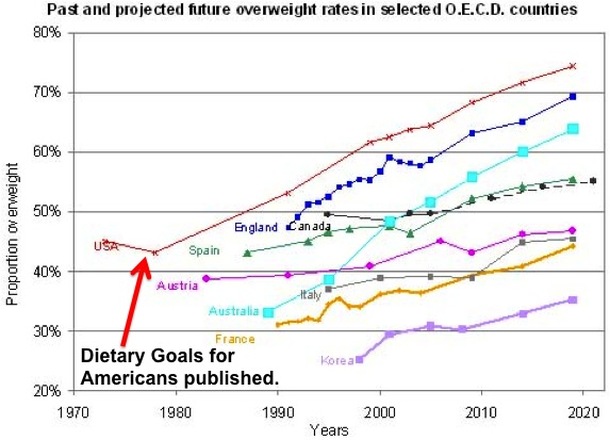
Since the Dietary Goals for the United States were published in 1977 suggesting everyone increase their carbohydrate intake and decrease their fat intake, has there been any evidence to support this recommendation? Find some and win money.


Challenge

The challenge is simple:

1. Find clinical trials supporting today's standard of care as compared to a low carbohydrate diet. A randomized control trial in which a calorie-restricted, low fat, diet results in more weight loss than a low carbohydrate diet, with or without a calorie limit. (Criteria)

2. Submit them by email to info@awlr.org.

3. Donate to the pot and increase the stakes.

After the challenge has concluded, the person(s) who find such trials will win a 40% of the donation pot. The remaining 60% (or entire pot if no winners) will be donated to theNutrition Science Initiative*.

History

In February of 1977, the first ever Dietary Goals for The United States were released, in response to the fact that "six of out ten of the leading causes of death have been linked to our diet." The Government, the report explains, "has an obligation to acknowledge this. The public wants some guidance, wants to know the truth, and hopefully we can lay the cornerstone for the building of better health for all Americans, through better nutrition."

What ensued for the next 35 years was the largest increase in obesity the world has ever seen.
Picture
Not all members of the Dietary Goals committee were in agreement. Charles H Percy, a Ranking Minority Member voiced his concern for what was being done:
In fact, because I recognize many will read or hear only about the Dietary Goals….I feel the American public would be in a better position to exercise freedom of dietary choice if it were stated in bold print on the Goals and Food Selection pages that the value of dietary change remains controversial. And that science cannot at this time insure that an altered diet will provide protection from certain killer diseases such as heart disease and cancer…I recognize the desirability of providing dietary guidance to the public ... In my judgment, however, the best way to do this is to fully inform the public not only about what is known, but also what remains controversial regarding cholesterol, the benefits of dietary change, and the reliability of food intake data. Only then, will it be possible for individual consumers to respond optimally to the Dietary Goals in this report.

Of course, many changes occurred during this time period which could have independently contributed to the obesity epidemic, and simply implicating this correlation as proof that the dietary goals were the cause would be naive and irresponsible. However it is reasonable to ask a simple question:
Graham

Women wake up grumpier than men because they need more sleep !


Researchers studied the sleeping habits of 210 people and found that women who didn't get enough sleep were 'more hostile and angry' in the mornings compared to men who got the same amount of time in bed.
In a report out earlier this month, scientists at Duke University in North Carolina, USA, said that differences in hormones meant women needed more sleep than men.
The research found that women suffer more "mentally and physically" if they don't get a good night's sleep compared to men as they need more time asleep to "keep their hormones in balance".
Edward Suarez, an associate professor at the university, said: "The study suggests that poor sleep - measured by the total amount of sleep, the degree of awakening during the night, and most importantly, how long it takes to get to sleep - may have more serious health consequences for women than for men.
"We found that for women, poor sleep is strongly associated with high levels of psychological distress, and greater feelings of hostility, depression and anger.
More here.
I love this comment.
"This is very true, my wife wakes up like a bear with a sore head.....and that's before I've attempted a dawn strike. She makes up for it in other ways mind!!!"

Eddie


Tuesday, 12 March 2013

Sid (Mr Portion control) Bonkers way off the mark yet again!


A couple of quotes from Sid:

“Low carb diets have been found to be useful in the "short term" Diabell, unfortunately they are not so useful in the long term as most people are simply unable to stick to a very low carb diet long term as witnessed here by anyone who has been a member here here for more than a couple of years, time and time again we see those on a very low carb diet say that their "weight loss has stalled" or that they "fell off the wagon" even some that have put back most of the weight that they lost initially on a low carb diet, others who recommend a diet that does not work for them yet still pioneer the low carb ethos.”

A few names for Sid that he should remember and have stuck with LowCarb long term all at least four years since diagnosis and on minimum or no medication:

Hanna, IanD, Wiflib, Clearviews, Ray, John, Eddie, Bluenosesol and yours truly.


“Far from being well proven that todays "standard" diet (whatever that is) has been found to be downright bad for you it has been proven many times that the best diet is one that contains all food groups, how can it be better to eat a very low carb diet that then needs to be supplemented with vitamins and minerals that are lacking with out carbs?”

 It’s a complete myth that LowCarb is lacking in vitamins and minerals, it’s also a myth that we don’t eat carbs, we just keep to nutritionally dense LowCarb fruits and vegetables.


Graham


Quote of the week !

"The NHS diet advise is not all bad but seems to be misinterpreted by some. Despite what some may say the NHS diet advise is based on fact and scientific research unlike opinions which are based on repeating inaccurate anecdotes."

From Mr. Bonkers here. That old med's pusher never gives up.

Eddie